
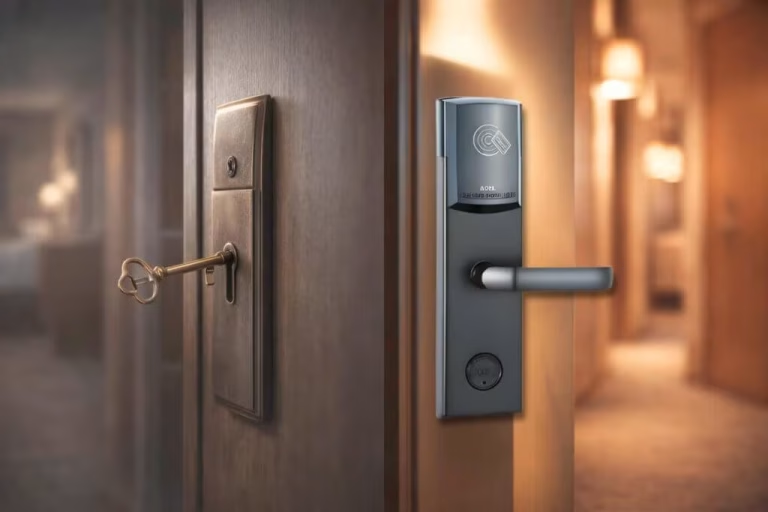
Direct Answer:
- Electronic hotel locks open when a guest presents a verified credential: an RFID key card or a smartphone mobile key.
- The reader, a microcontroller, or a motor or solenoid moves the bolt. When a guest taps a card or phone against the lock.
- The reader decodes the encrypted credential, the microcontroller verifies it matches the authorized data for that room and time period, and if valid, the motor retracts the bolt in under one second.
- The lock simultaneously reports the entry to the hotel’s property management system (PMS), which controls access, sets expiry times, and keeps audit logs of who entered when.
In short, a guest checks in (often at a kiosk), receives a digital key or RFID card, taps it on the door, and the lock verifies the credential locally and grants access in under a second.
Electronic hotel locks have replaced traditional keys almost everywhere.
When you check into a hotel today, you tap a card or phone on the door and walk straight in, all within a second.
But how do electronic hotel locks work behind that simple action?
>>See the revolution of hotel door locks.
The answer sits in a chain of technology: encrypted credentials, radio readers, motorized bolts, and a management system quietly tracking who can enter which room, when, and for how long.
Understanding how electronic hotel locks work is essential if you’re a hotel owner evaluating new systems.
This guide explains exactly how electronic hotel locks work, from the components inside the lock to the systems that issue keys and grant access.
As a hotel owner, you’ll understand the ‘how’ and ‘why’ by the end.
What Are Electronic Hotel Locks?
Electronic hotel locks are battery-powered locks that use encrypted digital credentials (RFID cards or mobile keys) instead of mechanical keys. When a guest presents a credential, an internal reader decodes it, and a microcontroller verifies it matches the room’s authorisation window. If valid, a motor releases the bolt in under one second.
An electronic hotel lock is a smart lock that grants access using a digital credential.
Rather than a cut metal key turning pin tumblers, the lock contains an embedded reader and a small computer (microcontroller) that checks whether the presented credential is valid for that specific room and time period.
If approved, a motor or solenoid retracts the bolt, and the door opens.
The advantage: because the credential is data, not a physical shape, your team can issue it instantly, set it to expire automatically (e.g., at check-out), and revoke it at any time.
The lock also logs every entry for security and audit trails.
How Do Electronic Hotel Locks Work: Step by Step
A guest checks in and receives an RFID card or digital key, then taps it against the lock’s reader. The reader sends the credential data to a microcontroller inside the lock, which verifies it against the room’s authorized credentials and time window.
If valid, the microcontroller signals the motor to retract the bolt. The lock also reports the access to the hotel’s property management system for logging and audit purposes.
The process from arrival to room entry unfolds in these steps:
- The guest checks in (at a self-check-in kiosk or at the front desk) and verifies their identity through a booking reference, passport, or IC.
- The check-in system encodes a credential: it writes encrypted access data onto an RFID card or issues a mobile key (a QR code) to the guest’s phone.
- The credential is linked to one room only and is valid only for the specific stay duration (check-in to check-out).
- At the door, the guest taps the card or phone against the lock’s reader.
- The reader captures the signal and passes the credential data to the lock’s microcontroller.
- The microcontroller verifies the credential locally against the room’s authorized access list and checks that the time is within the validity window.
- If both checks pass, the microcontroller sends a signal to the electric motor, which releases the bolt in a second.
- The lock stores a local access log (timestamp, credential used) and also sends a report back to the PMS server.
- The door opens, and the guest enters their room.
What Is Inside an Electronic Hotel Lock?
An electronic hotel lock contains five core components: a reader (antenna that picks up the credential signal), a microcontroller (small processor that verifies the credential), a motor (moves the bolt), a battery (powers the lock for ~1 year), and a mechanical override (backup key or power port for emergencies).
Understanding the five core parts inside an electronic hotel lock helps explain why these locks are both fast and secure. Each part plays a specific role:
1. Reader
The reader is an antenna or sensor that detects and decodes the RFID card or mobile key signal.
When a guest taps their card or phone on the lock, the reader receives the radio-frequency transmission and extracts the encrypted credential data.
2. Microcontroller
The microcontroller is the lock’s brain, a small computer chip inside the lock body.
It receives the credential from the reader, checks it against the room’s authorized credentials stored in local memory, verifies the current time is within the credential’s validity window, and decides whether to grant or deny access.
3. Motor or Solenoid
This is the mechanical actuator that physically releases the bolt. When the microcontroller approves access, it sends a signal to the motor, which moves the bolt out of the doorframe.
Once the guest enters, the bolt locks the door again.
4. Battery
Electronic hotel locks run on batteries (usually AA or 9V) rather than mains power. A typical set lasts around one year of normal use.
The lock continuously monitors its battery level and alerts staff when power is low, so the lock rarely fails without warning.
5. Mechanical Override
Every electronic hotel lock includes a backup mechanical key cylinder or an emergency power port.
This ensures staff can always open the door if the electronics fail, the battery is dead, or the network is down. It is a critical safety and accessibility feature.
How Electronic Hotel Locks Open: Two Access Methods
Electronic hotel locks open in three ways:
- RFID keycard: guest taps a card on the reader
- Mobile/digital key: guest taps their phone via Bluetooth or NFC
Modern hotels typically use one or more of these methods:
1. RFID Keycard
RFID keycards open the lock when a guest taps a contactless card containing an encrypted chip. RFID stands for radio-frequency identification.
The card holds a tiny chip and antenna, and when brought close to the lock’s reader, the chip transmits its encrypted credential by radio signal.
The lock verifies the data and unlocks. The card requires no battery and no physical contact, just a light tap.
RFID is the most widely used method because it’s reliable, inexpensive, and familiar to guests.
2. Mobile and Digital Keys
Mobile key locks let guests unlock the door with their smartphone using Bluetooth, NFC, or a scanned QR code.
After check-in, the guest receives a digital credential on their phone, often through the hotel apps.
They unlock the door without ever queuing for a physical card.
Your staff can issue or revoke a mobile key remotely through the property management system at any time, making it both convenient and easy to control access.
Mobile keys benefit both sides:
- ● Guests skip the front-desk queue entirely and can check in 24/7.
- ● Staff can revoke access instantly if a phone is lost or a booking changes.
- ● Hotels cut the cost and environmental waste of producing plastic keycards.
How the Two Access Methods Compare
RFID keycards are the most common and reliable; mobile keys offer contactless convenience and remote control. Hotels often use a combination of both two to accommodate guest preference.
Each access method suits a different priority or use case:
Method | How it Opens | Best For | Main Advantage |
|---|---|---|---|
RFID Keycard | Tap card on reader | Most hotels; universal method | Reliable, cheap, familiar |
Mobile Key | Phone via Bluetooth/NFC/QR | Tech-savvy guests; contactless stays | No queue, remote revoke |
How Electronic Hotel Locks Verify Access
When a credential is presented, the lock’s reader sends it to the microcontroller, which checks three things:
- Is the credential encrypted correctly?
- Does it match an authorized credential for this room?
- Is the current time within the credential’s validity window (e.g., check-in to check-out)?
If all three pass, the lock opens. If any fails, the bolt stays locked.
The verification process happens entirely inside the lock, in only a second, using local authorization data. This means the hotel lock works even if the network is down. Here’s what happens behind the scenes:
- ● The lock reader decodes the credential and extracts the encrypted data.
- ● The microcontroller checks that the encryption is valid (hasn’t been tampered with).
- ● The microcontroller compares the credential against a list of authorized credentials for that room, stored in the lock’s local memory.
- ● The microcontroller reads the lock’s internal clock and verifies the current time falls within the credential’s valid start and end times.
- ● If all three checks pass, the microcontroller sends a signal to the motor. If any check fails, it denies access and logs the attempt.
This is why electronic locks are secure: even if someone steals a keycard or duplicates a phone key, they can’t use it outside the assigned time window or for a different room.
What Happens at a Self-Check-In Kiosk?
A self-check-in kiosk lets a guest verify their booking, receive an RFID card or digital key, and access their room 24/7 without waiting at the front desk. The kiosk reads a passport or booking reference, encodes the guest’s credential, and either dispenses a card or sends a digital key to their phone.
Self-check-in kiosks (Evernet Malaysia) automate the front-desk process, which matters most for late-night arrivals and busy check-in periods. The guest journey is straightforward:
- The guest verifies their booking on the kiosk using a reservation reference number, passport, or ID card.
- The kiosk pulls the booking information from the hotel’s property management system and checks the room status.
- The kiosk encodes the guest’s credentials with the room number and stay dates, then writes it to an RFID card.
- The guest collects the card from a dispenser slot or pickup tray on the kiosk.
- Alternatively, if the kiosk supports digital keys, guests will receive a QR code or Bluetooth token.
Explore the benefits of the self-check-in kiosk here.
Both the RFID card and the digital key are valid only for the guest’s stay dates. At check-out, both credentials automatically expire and stop working, which is a built-in security feature that prevents unauthorized access after the guest leaves.
How Electronic Hotel Locks Talk to the Property Management System
Hotel locks connect to the property management system (PMS) over a secure wireless network. The PMS issues credentials, sets validity windows, and receives access logs from the locks. This two-way communication allows the hotel to manage all keys on a single platform and audit every entry.
The property management system (PMS) is the brain of the access system. It controls which credentials work in which rooms and for how long, and it receives reports of all entries and access attempts.
When a guest checks in, the PMS issues the credential and tells the corresponding lock which credential to accept.
When the guest taps their key at the door, the lock reports back.
Through this connection, the PMS can perform these functions:
- ● Issue and encode RFID cards or mobile keys instantly at check-in.
- ● Set and update the validity period for each credential (e.g., until 11 AM checkout).
- ● Automatically revoke a credential if a guest checks out early or loses their key.
- ● Record detailed entry logs for every room, who entered (with which credential), when, and how many times.
- ● Allow staff to monitor room status, unlock doors remotely, and override access in an emergency.
- ● Generate audit reports for security, housekeeping, and compliance purposes.
The PMS and the locks communicate over a secure, encrypted WiFi connection, so the network itself is protected.
Why Modern Hotels Switched From Traditional Keys to Electronic Locks
Hotels switched to electronic locks because they improve security, cut operating costs, and meet guest expectations for seamless access. Digital credentials are encrypted, time-limited, and revocable; a physical key cannot be. For staff, electronic locks mean faster check-in, fewer lost-key calls, and accurate audit trails.
People can copy traditional brass keys, and your team can’t either track or cancel them once issued.
However, staff can issue digital credentials in seconds that expire on their own and leave an auditable record of every entry.
But now you understand how electronic hotel locks work and why they’re superior: staff can issue digital credentials in seconds that expire on their own and leave an auditable record of every entry.
That means less time managing the desk and fewer security headaches. For guests, it means a smoother, faster arrival.
The shift happened because guest expectations rose. Travelers now expect the in-room and arrival experience to be seamless. They want:
- ● No queue at the front desk, either mobile check-in or a fast kiosk.
- ● Contactless room access.
- ● Flexibility: the ability to check in early via their phone.
Electronic locks deliver all of these, which is why they are now the global standard rather than a premium feature.
About Adel Malaysia
Adel supplies and installs electronic hotel door locks and smart door locks for hoteliers and property developers across Malaysia.
With over 20 years in the access-control industry and more than 500 completed projects, Adel helps hotels move to secure, seamless, and centrally managed guest access.
Explore Adel hotel door locks, and talk to our team to see how our seamless solutions make your business operations smoother and your guests happier. The best of both worlds.
Frequently Asked Questions (FAQ)
Do electronic hotel locks have batteries?
What happens if the power goes out or the network fails?
How secure are electronic hotel locks compared to traditional keys?
Can a hotel keycard be copied or hacked?
How long does an electronic hotel key (RFID or mobile) last?
Can a guest be accidentally locked out of their room?
What is the difference between a hotel electronic lock and a smart home lock?
Can a guest stay in their room if the lock battery dies?
Are electronic hotel locks expensive to install?
Key Takeaways
- Electronic hotel locks open using RFID cards or mobile keys, not mechanical keys.
- Inside each lock: a reader (antenna), microcontroller (processor), motor/solenoid (bolt actuator), battery (~1 year life), and mechanical override (backup key).
- Verification happens in the lock itself and takes under one second: Is the credential encrypted? Does it match this room? Is the time valid?
- Credentials are encrypted, tied to one room, and expire automatically at checkout.
- The PMS issues keys, sets expiry, logs all entries, and lets staff manage access remotely.
- Self-check-in kiosks let guests collect RFID cards or digital keys 24/7 without staff.
- Electronic locks are more secure, cheaper to operate, and better for guest experience than traditional keys.
